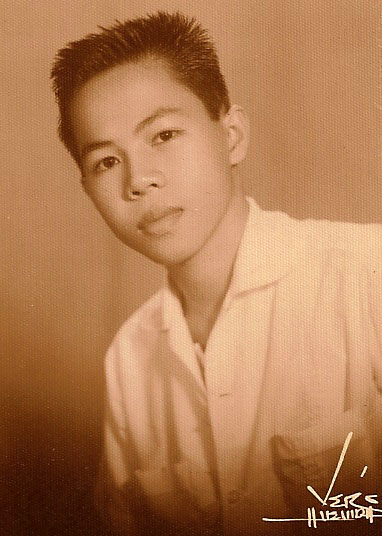
Here’s an unfortunately truncated version of an interview I did with my father back in 2020 about his upbringing and how he came to America in the late 1960s.
I’m grateful to have this small remembrance of him and his unique way of telling stories, which he loved to do.
EDIT OCTOBER 2026: Added Transcript
Transcript generated by Otter.ai on October 2026
Rik Panganiban 00:00
Hey Dad, can you hear me? Yeah. Okay. So is this all a good time to talk? Yeah. Okay. So I, so as I said, like I was thinking about like just all the stories that we told at your brother’s funeral, and thinking about, you know, how much I know and I don’t know necessarily about your life before you were my dad. Yeah. And so I thought this would be just a fun time to kind of get a little bit more background on a little bit of your story before I knew you. And there’s obviously a lot of things that we could focus on, but the part that I think that I’m interested in right now, if that’s okay, is just when you came here from the Philippines and immigrated to America. And I thought we just talk about that for like you know like the next like 3-40 minutes if that’s okay.
Dad 01:13
Yeah, of course it’s going to be a long story, but I will make it concise and relevant, and also probably do my best to shorten the period because I came here when I was about 23 to 24 years old, and lived, of course, most of my life in the Philippines before that. So I don’t really know where you want me to start, but well,
Rik Panganiban 02:08
Could we start with a little bit of background? So I guess I don’t know too much about, like, in the Philippines at that time when you were growing, when you’re, let’s say, when you’re a young man. And people talk about like, oh well, I have an opportunity to like work in America, or I have an opportunity to like, you know, be a student in the United States. Like, what would that mean to another Filipino? Like, what do they know about living in America? And like, what does their imagination kind of bring up for them.
Dad 02:44
Yeah. Well, first of all, I think the best time to start is how I became a doctor. Because it would be a close enough period from the time I decided to go to medicine to the time I decided to go to America. So just a little bit of background. I’m part of a large family. Actually the fourth in a family of seven. So I was in the middle. And born in Polillio, Quezon. And as my family or our family got bigger, my parents wanted to provide us a better future, in getting an education. And we don’t have the means to send me to college. So early on they decided to send me out for adoption. Because my auntie, who is my adopted mother, was childless and wanted to have their own, but she couldn’t for some reason. So it was a perfect match, because, number one, she’s a relative. She’s childless. And number two, for my parents, I wanted to, I mean, they wanted me to have a better future. So early at an early age of about three, that’s how excited they were. They said, “Well, let’s have myself be adopted by my auntie.” So even though I was adopted, I knew already at that time who my brothers and sisters were, who my natural parents were. And part of it because we’re still related, and we live close to each other. All right. So my adopted mother was married to an army U.S. Army veteran, his name was Miguel Panganiban. He is my adopted father. And since they have no kids, they are able to pass on the benefits of a United States Army veteran to their child, which is myself. So I did have educational benefits, and that allowed me to go to school.
Dad 06:22
So originally I didn’t want to be in medicine because I believe it was a long and difficult profession. And I was in a hurry to go to work and earn some money. At that time, my idol was an uncle who was a civil engineer who worked for the government, and he seemed to have a good life. He has his own house. He had a lot of friends, and he was district engineer in his area, and he was well respected. So I thought that that would be my pathway. I want to be just like him. But my adopted mother disagreed with me and said, “No, you’re not going to be like him. You’re going to be a doctor.” And I said, “But why? It’s too long. I’m not sure I have the patience or the time or the intellect of being a doctor.” She said, “Well, first of all. Don’t worry about the tuition because it’s free. It’s your benefits, and I want to maximize, I want to maximize the benefits.” Because she said that you can take any course and the government, U.S., United States government, at that time would pay for your tuition.” So she chose a degree that is the most expensive and the longest. You know. So that is medicine, and I said, “Well, okay.” And then the other reason he said is, “I want you to go to America. Because at that time there were two, two….”
Rik Panganiban 08:59
Okay, all right. So we are at 1968. You’ve passed the entrance exam to come to the U.S. You’ve just worked. You just worked for two years at Clark Air Force Base. So this is your first time to leave the country. Had you ever flown before, Dad?
Dad 09:26
Have I ever what?
Rik Panganiban 09:28
Been in a plane before.
Dad 09:32
Wait a minute. Hmm. To think about it, no. That was your first time. Yeah, first time. There’s no reason for me to go anywhere by plane. I’ve never been out of the country. Never been to Hong Kong. I’ve never been to other Asian countries. I was, remember, from the time I graduated from high school, 1960, I never stopped going to school. Yeah, I had no vacation. I didn’t have summer vacation. I and then from… on Clarkfield, that is a two-year contract. So, yeah, I’ve never gone anywhere. All I did was school and work.
Rik Panganiban 10:37
So you so and then you got the opportunity to go. Where was your placement?
Dad 10:44
Well, I got accepted at a internship in Phoenix, Arizona. 1968.
Rik Panganiban 10:57
Did you have any choice, or was it just like you just got told this is where you’re going?
Dad 11:03
I had a lot of choices. Yeah. But just remember, your mom and I were already kind of like boyfriend-girlfriend in the Philippines for the last two years before we came here. And when we decided to come here, we had to choose a program that will accept both of us. I cannot be in Arizona, and she will be in New York, you know. So it’s hard, and this is a matching program. That, in other words, you have to be matched, you know, together in one place. And we… this is the only place that match both of them. Yes, we applied in many places, but then some places will accept me, some places will accept her, but not both.
Rik Panganiban 12:14
Yeah. So okay, that makes sense. And then when you accepted it, how much did you know about either the place or Phoenix, Arizona.
Dad 12:24
I’ve never heard about Phoenix, Arizona. I don’t know anything about it. I know it’s in America. But I have no idea what the town was like, or… I’m not even sure I know whether it is… or the geography part, you know. I just know it’s in America. You know.
Rik Panganiban 13:00
Like, so you couldn’t go to the library and like look it up or like, you know, ask anyone.
Dad 13:08
Let me tell you, right now we live in a different age. And I know you can look it up. But here we have all the convenience. You have Google. You have a cell phone. You have internet. So what do we have in the Philippines? We have the encyclopedia. Okay. But you have to go to the library. Who has time to go to the library? I don’t even know where the library is. It doesn’t. I’m not sure. It’s that. It’s that inconvenient. And then… there’s absolutely no way. I mean, the effort is so much. Just remember, it’s like being in Stone Age.
Dad 14:14
Okay, the first time I growing up… The first time I found out that there was this thing called the telephone, I was already in high school, and my father worked in a grocery store, and they have a telephone, and I was so amazed that there’s a telephone there, you know. And then I grew up with no television, no TV sets at all, and then when I was in high school, that was the first time I saw an escalator. You know, it was first installed in the airport, Manila International Airport, and we would travel to the airport so we could ride the escalators. No. Yeah. Wow. And I was already in high school.
Dad 15:30:
Okay. Now, when I came to America, I was an intern. We didn’t have a telephone. There was a telephone, but if you call the Philippines, it will cost you your whole month salary because it’s that expensive. So there were no calls, or there’s no email, there’s no Skype, there’s nothing, and guess what? Snail mail, snail mail, and you know how long it took for snail mail. It doesn’t go by airplane. It goes by boat. At least at least a month, one month of the mail. So just imagine, I was thrown into a strange land with strange food, strange costumes, and absolutely almost no contact with my family back home. None, except mail, except mail, you know. So that’s how backward we were.
Dad 16:50
And when I left the Philippines, coming to America, the only thing I know about America is what I see in the movies. Okay, I thought that all Americans were wearing a suit because in the movie everybody wears a suit, you know. If you look at the old-fashioned movies, like Cary Grant movies and all that, they’re all wearing suits. So of course I had to have a suit made, and I didn’t want to stand out. So I wore a suit coming to Phoenix, Arizona, in July of 1968. And I thought, America is cold. So when I stop over in Hong Kong, there was an Indian merchant who said, “Oh, you’re going to America?” I said, “Yes.” “You know, America is cold. There is snow there. You have to wear a coat.“ I said, “Oh yeah, I don’t have money. I only have $50.” He said, “Well, perfect. I have a suit for you.” So he sold me a suit. It’s so funny, it was made of wool.
Rik 18:19
Oh no!
Transcribed by https://otter.ai