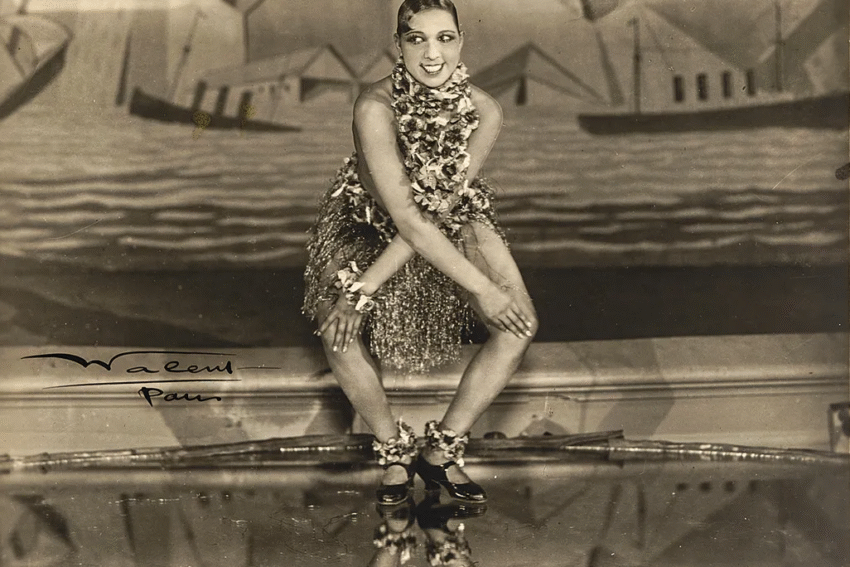
I’ve been reading the memoirs of Josephine Baker (first published in 1949), which are such a trip. Baker an iconoclastic bad ass — a Black American who left for France to live life in her own terms, a dancer, singer, actor, activist, spy, and statesperson.
I’m still learning about her incredible life, but one thing seems clear: she wasn’t interested in fitting into other people’s conceptions of who she was supposed to be or supposed to act. She was truly transgressive.
When she arrived in Europe in the 1920s, people didn’t know what to make of her. Was she a woman, a man, something else? She didn’t move in any way that was expected — feminine and alluring one moment, saucy and sensual the next, and silly and wild right after. “Sauvage,” as the French would say it, some in horror and others in admiration.
Here’s one review of one of her early dance performances from the publication Candide written by Pierre de Regnier:
Much has been said about it already. Some people have returned twice, some even six times. Others still have stood up abruptly during a scene change and left, slamming the door behind them, outraged by the madness, the moral degradation and the worship of inferior deities.
The revue begins at a quarter past ten.
The whole of Paris is there, in that darkened room.
The musicians of the Negro orchestra, instruments in hand, march single file into the darkness in front of the pearl-gray curtain.
The curtain rises.
We are in a port at night, somewhere far away. On the moonlit quay are cargo ships and goods-and women.
Wearing shirts, or dresses, if you wish, and tignons, they enter one behind the other to sing a little tune. These are the “showgirls,” who, onstage, almost appear to be white— all of them but one.
The Charleston.
At this point, a peculiar character takes very quickly to the stage, walking with knees bent, dressed in ragged shorts, resembling a boxer kangaroo, Sen-Sen Gum, and a racing cyclist all at once.
This is Josephine Baker.
Is it a man? Is it a woman? Her lips are painted black, skin the color of a banana, her already-short hair pasted to her head as if it were dressed with caviar. Her voice is high-pitched and she shakes with a ceaseless tremor, her body squirming like a snake or, more precisely, as if it were a living saxophone and the sounds of the orchestra were coming out of her … She twists around and pulls faces, crosses her eyes and puffs out her cheeks, contorts herself, does the splits and, to finish, leaves on all fours, legs stiff and rear higher than her head, like a baby giraffe.
Is she horrible, is she delightful, is she black, is she white, does she have hair or is her head painted black? Nobody knows. There is no time to find out. For here she is again, quick as a one-step tune, and she is neither woman nor dancer but something as extravagant and fleeting as music itself, the ectoplasm, so to speak, of the sounds we are hearing.
And now, the finale.
We are in a nightclub.
A barbaric dance performed by the girls and Josephine Baker. This dance, of a rare unseemliness, is a triumph of lewdness, a return to the mores of an earlier age: a declaration of love, made in silence and with the arms in the air, with a simple forward movement of the stomach and a quivering of the behind. Josephine is completely naked, with one small garland of red and blue feathers around her waist and another around her neck. The feathers flutter in time to the music, growing gradually more frenetic.
Josephine twirls in her plumage, the girls cry out, and the curtain falls to a colossal rumble of the drums and a final crash of the cymbals.
This early footage of her shows how radical her dancing was to European audiences in the early 20th century.
European governments would literally debate in their parliament halls whether or not she should be permitted to perform in their cities. People would get into fist fights during her concerts. Men would become obsessed with her, showering her with gifts and stalking her everywhere.
But she never let any of that prevent her from being who she knew she was meant to be.